

On 24 April 2026, Riverchain successfully hosted an ESG seminar themed “Unlocking Business Success: The Strategic Advantage of ESG Reporting for Subcontractors.” The event brought together a distinguished panel of experts, including Mr Allen Wong from Chun Wo Construction & Engineering Co. Ltd., Dr Lian Chan from the Hong Kong Registered Contractors Association, Dr James Xiong from Egis Group, and Mr Herman Cheng from Climate Finance Asia.

Together, the panellists explored a pressing question facing today’s construction subcontractors: why proactively preparing ESG (Environmental, Social and Governance) data and documentation has become a critical differentiator in an increasingly competitive market.
Why ESG data matters to subcontractors?
The Hong Kong Stock Exchange (HKEX) has progressively tightened ESG disclosure requirements for listed companies, aligning with International Financial Reporting Standards (IFRS S2) and international standards. This signifies that ESG reporting is no longer an optional brand promotion but a legally binding regulatory obligation. Non-compliant listed companies and financial institutions will face enforcement actions, reputational damage and investor scrutiny [1].
For subcontractors, the most critical change lies in the “Scope 3” emissions disclosure requirements for main contractors. According to HKEX regulations, large listed companies will be mandated to disclose their Scope 3 emissions data within their value chain starting from January 1, 2026. As part of the main contractor’s supply chain, the emissions generated by subcontractors’ operational activities (e.g., procurement of goods, equipment, and transportation) will directly impact the main contractor’s Scope 3 reporting [1]. Therefore, subcontractors must actively cooperate and provide relevant data to maintain their partnership with main contractors and seize new business opportunities.
How should subcontractors prepare in advance?
To meet increasingly stringent ESG requirements, subcontractors should focus on the following three areas for early preparation and data collection:
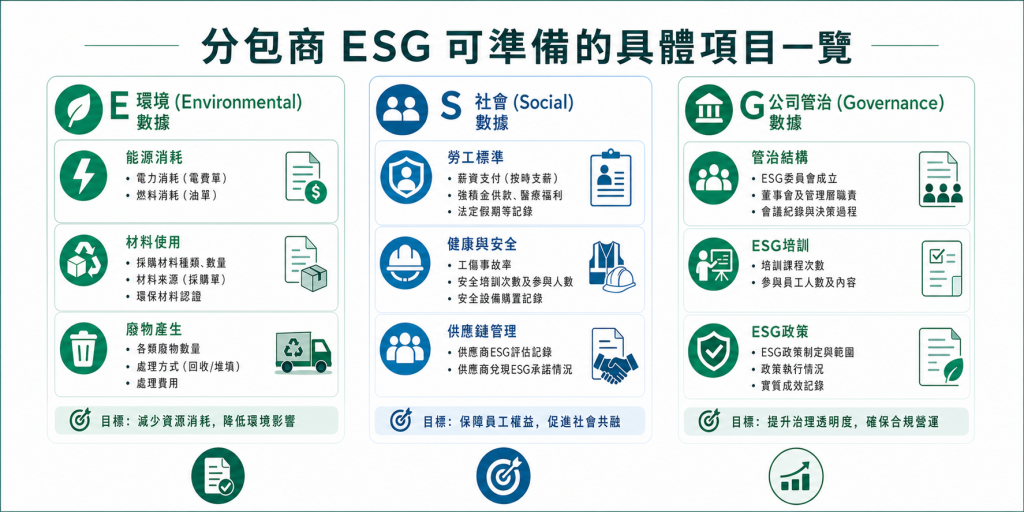
1. Environmental data
Collecting environmental data is fundamental to ESG reporting. Subcontractors should establish internal mechanisms to systematically track and record the environmental impact of their operations. Key data points include:
- Energy consumption: Record electricity consumption (from utility bills) and fuel consumption for company vehicles (from fuel receipts). This helps calculate Scope 1 (direct emissions) and Scope 2 (indirect emissions) greenhouse gas emissions.
- Material usage: Track the types, quantities and sources of procured materials (from purchase orders). Prioritise environmentally friendly materials and document their environmental certifications.
- Waste generation: Record the quantity, disposal methods (recycling, landfill), and disposal costs of various waste generated during construction (e.g., construction waste, domestic waste). This helps assess waste management efficiency.
2. Social data
Social responsibility is a vital component of corporate sustainable development. Subcontractors should focus on employee rights, health and safety and community relations. Relevant data includes:
- Labour standards: Record employee wage payments (on-time payments), MPF contributions, medical benefits and statutory holidays. Ensure compliance with labour laws and promote fair labour practices.
- Health and safety: Record accident rates, the number of safety training sessions and participants and purchased safety equipment. Establish a robust occupational health and safety management system.
- Supply chain management: Evaluate suppliers’ ESG performance and ensure their compliance with social responsibility standards. Record how suppliers fulfil their partners’ ESG commitments.
3. Governance data
Good corporate governance is another crucial part of ESG reporting. Subcontractors should establish transparent and efficient governance structures to ensure fairness and compliance in decision-making processes. Key data points include:
- Governance structure: Establish an ESG committee and clearly define the responsibilities of the board and management in ESG matters. Record committee meeting minutes and decision-making processes.
- ESG training: Record the employees’ attendance and content of ESG training courses to enhance their ESG awareness and capabilities.
- ESG policies: Develop and implement comprehensive ESG policies covering climate change, resource management, waste disposal, occupational health and safety, labour rights, anti-corruption and supply chain management. Document the implementation and substantive effectiveness of these policies.
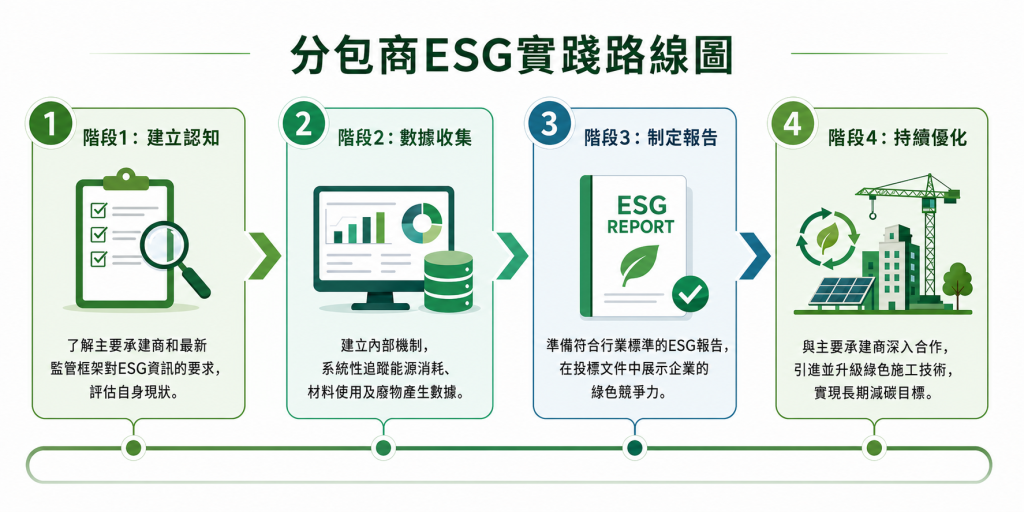
Subcontractor ESG practice roadmap
During the seminar, Allen from Chun Wo Construction proposed an ESG practice roadmap for subcontractors, providing clear guidance and reference:
- Phase 1: build awareness
Understand the ESG information requirements of main contractors and the latest regulatory frameworks, then evaluate the current status. - Phase 2: data collection
Establish internal mechanisms to systematically track energy consumption, material usage and waste generation data. - Phase 3: prepare report
Prepare ESG reports that meet industry standards, showcasing the company’s green competitiveness in tender documents. - Phase 4: continuous optimisation
Engage in in-depth collaboration with main contractors to introduce and upgrade green construction technologies, thereby achieving long-term carbon reduction goals.
Strategic advantage of preparing ESG data for subcontractors
For subcontractors, early preparation and systematic collection and management of ESG data are not merely compliance requirements but crucial strategies for enhancing competitiveness, expanding market opportunities and achieving sustainable development. Specifically, these data can bring the following significant advantages to subcontractors:
- Increasing the tender award rate and business opportunity
Subcontractors with comprehensive ESG data and reporting capabilities can satisfy the Scope 3 disclosure requirements of main contractors. This allows them to stand out during the tendering process, increasing their chances of winning tenders and establishing a stronger, trust-based partnership. ESG performance has become a significant evaluation criterion for many large projects. - Provides a more comprehensive analysis for financing institutions
Clear and verifiable ESG data serves as an important “non-financial disclosure” basis for financing institutions to assess corporate credibility. Good ESG data enables financing institutions to conduct a more comprehensive analysis of subcontractors, potentially leading to lower financing costs and improved liquidity. Click here to contact us and learn how to flexibly and quickly obtain working capital. - Strengthened corporate image and risk management
Proactive ESG performance helps build a positive corporate image, attract talent, and effectively identify and address potential operational, legal and reputational risks through systematic management of environmental, social, and governance factors, laying a solid foundation for the company’s long-term stable development.
Conclusion
ESG reporting has become an unavoidable trend for construction subcontractors and a golden opportunity to enhance competitiveness. Early preparation and systematic collection and management of environmental, social, and governance data will not only help subcontractors comply with regulatory requirements but also earn the trust of main contractors and open new business collaborations. Let’s work together to build a greener future!
References
*Information excerpted from a presentation by Mr Allen Wong of Chun Wo Construction & Engineering Co. Ltd., supplemented by insights shared by guest speakers during the seminar.
[1] New ESG Reporting Requirements and HKEX Climate Compliance - Heinbro Consulting